
Innovation.
A magician's method.
A 45-minute keynote on innovation, arguing that the people who find non-obvious solutions aren't smarter; they're looking at the problem differently. Scott Henderson has spent twenty-five years making the impossible look inevitable on stage. That's the mental discipline the talk unpacks.
Trusted by leading organizations
The magician's
method.
Innovation isn't having better ideas. It's being willing to look in places other people don't. Magicians are relentless about this. To make a card appear folded inside three nested boxes that have been held by the audience the entire time, the answer has to come from a direction the audience wasn't watching. Innovation is the same problem at a bigger scale.
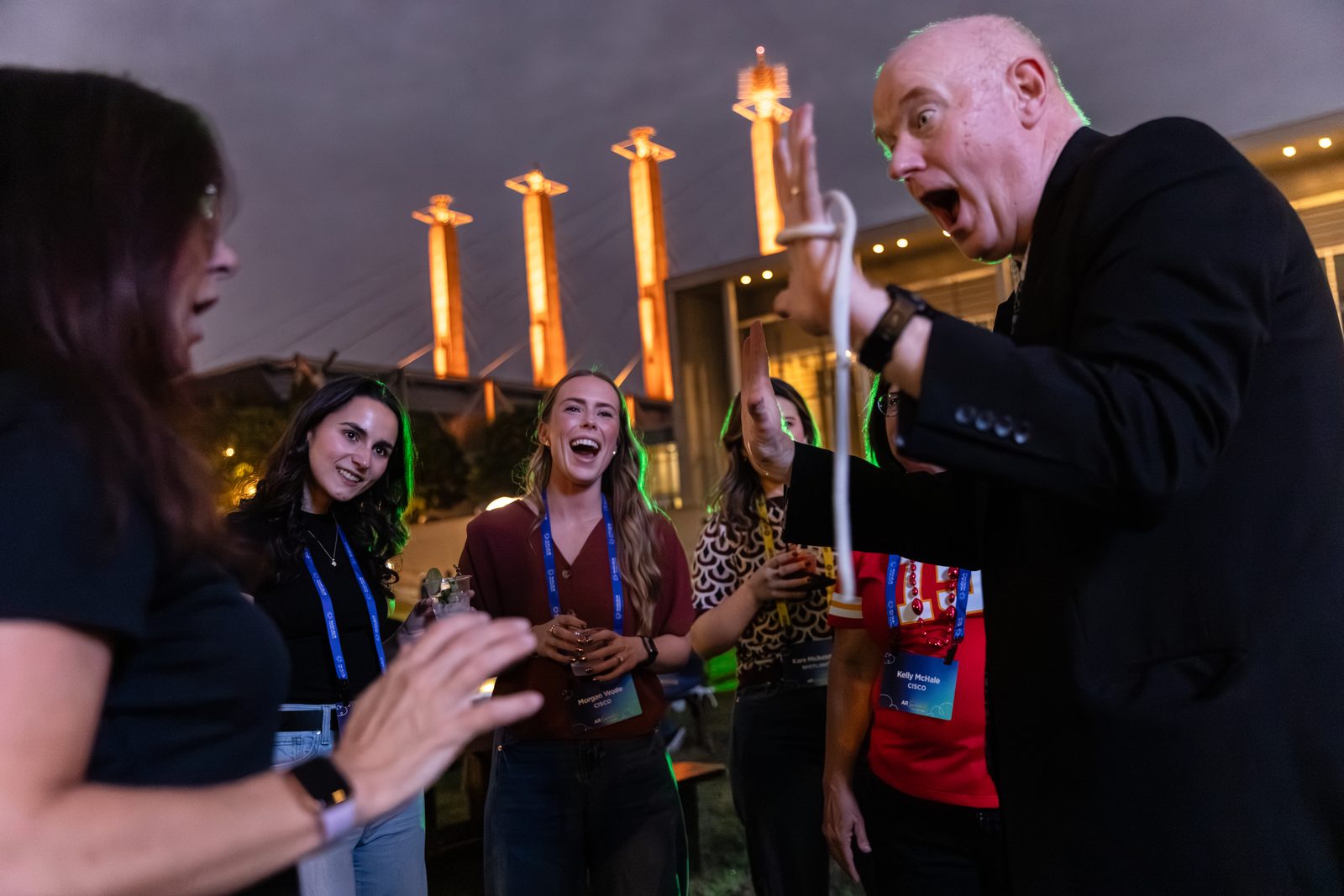
Scott Henderson has been professionally doing the impossible for twenty-five years, performing for the Kansas City Chiefs, Hallmark, Pfizer, T-Mobile, LinkedIn, and hundreds of Fortune 500 companies. The craft of a working magician is almost exactly the craft of an innovator: inventing solutions that others will call impossible, and then executing them so cleanly that people assume they were obvious all along.
The keynote argues that every company has "magic tricks" sitting in plain sight: problems that look impossible to solve because the team is watching the wrong thing. It teaches the five ways a magician identifies where to look instead, and then demonstrates one of those patterns with a live piece of impossible magic the audience can't rationalize away.
This keynote works best for: innovation and R&D leadership, strategy offsites, product teams, annual meetings with an innovation theme, corporate technology summits, and any organization trying to break out of incremental thinking.

Three ways
to run it.
-
I.
45 min
The 45-Minute Keynote
Standard format. Scott delivers the talk with a live magic demonstration at the center. Audiences leave with five specific patterns they can immediately apply to a problem they've been stuck on.
-
II.
3 hrs total
Keynote + Application Workshop
The keynote, followed by a 90-minute application workshop where teams work through a real problem from their own business using the magician's-method framework. Scott facilitates. Surprisingly productive.
-
III.
4 hrs
Innovation Summit Half-Day
For a dedicated half-day innovation summit: opening keynote, team working sessions applying the patterns, closing feature. For clients who want innovation to be the day's focus, not a one-hour feature.
What gets
customized.
Every engagement begins with a conversation. You tell Scott about the evening: the audience, the tenor, the outcome you're trying to land. What reference material the room will find funny. Whether there's a retiring executive whose thirty-year tenure deserves a callback. A product launch you want built into the closing illusion. A sales number the CFO wants celebrated.
These details get written into the arc of the show before the night ever comes. The work happens before Scott arrives, not on stage.
What the venue needs to provide. Very little. A defined performance area and an outlet within fifty feet of the stage. Scott brings his own props, his own lighting where needed, and a full professional wireless microphone and PA system; a venue mic is optional, never required. His PA is also available for the client's use during the evening if you want it for music, announcements, or another speaker. He arrives early, works the room before the show, and leaves you free to focus on the hundred other things a corporate event has running.
Audience range. Twenty people in a boardroom, a thousand in a hotel ballroom, or any number between. For very large rooms, confidence monitors or a house camera feed are standard; most venues that size already run them.
Scoped to
your engagement.
The keynote is custom-quoted based on runtime, audience size, workshop add-on, travel, and any industry customization. Standard keynote fees generally land in the mid-five-figure range for Fortune 500 engagements. Workshop add-on priced separately. Proposal within 24 hours of a conversation.
Personal reply within twenty-four hours of inquiry, followed by a proposal. Holds are released in the order received.
Scoped individually. Final figures depend on format, audience, travel, and custom content.
Scott also performs for adult private parties and milestone birthdays and children's birthdays. Different formats, same standard.
The usual
asks.
Is this really connected to business innovation, or is it just a magic show with 'innovation' in the title?
Legitimately connected. The craft of professional magic is structurally identical to R&D problem-solving: define a constraint that looks impossible, enumerate every possible path, eliminate the ones an audience would spot, invest years of work perfecting the remaining path, present the result as inevitable. That's how magic tricks are invented. It's also, nearly word-for-word, how product innovation works at high-performing companies.
Is this the same talk as the creativity keynote?
They share a few underlying ideas about perception but land on different practical frameworks. The creativity keynote is about generating ideas: the pattern of seeing possibilities others miss. The innovation keynote is about executing them: the discipline of building solutions that look impossible from the outside. Some clients book both for a two-part conference.
Who has booked this keynote?
Corporate strategy teams, R&D leadership offsites, innovation summits, product leadership retreats, and industry conferences. Works especially well for technology, manufacturing, and services companies where incremental thinking has become the default.
What are the five patterns?
Scott outlines them in full during the keynote, but in preview: re-framing the constraint (what if this rule weren't true), audience attention modeling (where the users aren't looking), solving from the reveal backward (what would the ideal outcome require), parallel pathway redundancy (three ways to the same outcome, pick the one least expected), and over-investment in the invisible (the work your customer never sees is where the magic lives).
What audience size is this a fit for?
The keynote scales from 30-person leadership retreats to 800-person industry conferences. The workshop add-on works best at 40 attendees or fewer.
Can you customize to our industry?
Yes. Scott will study your industry, your product, your specific innovation challenges, and build industry-specific examples into the talk. The magic stays the same; the business examples change.