
School assembly magician,
Kansas City.
A thirty-minute, full-production magic assembly for elementary and middle schools across the Kansas City metro. Real lights, real illusions, real student volunteers on stage, and a positive message written into the show rather than tacked onto the end.
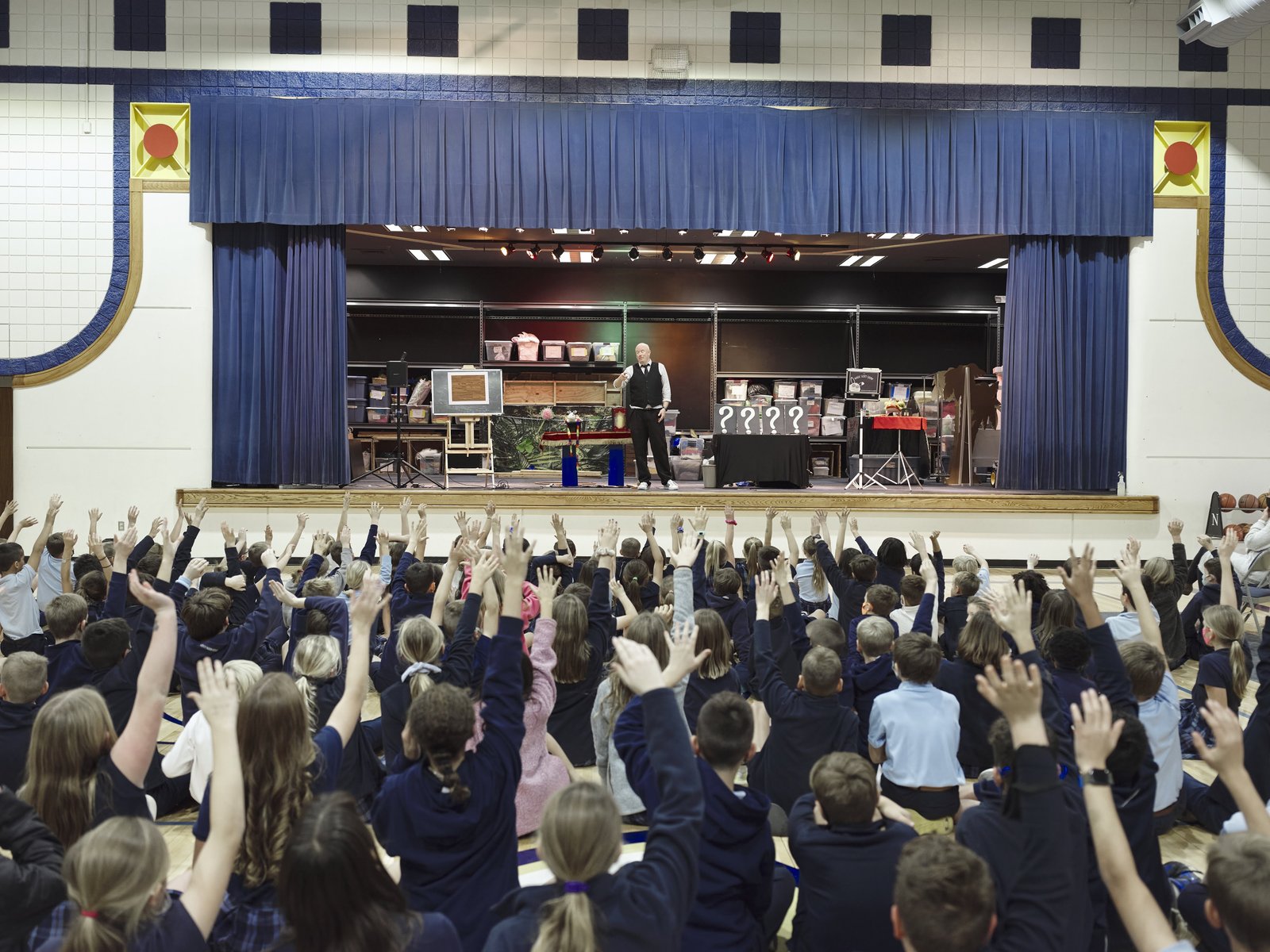
Booked by schools across the Kansas City metro
A real assembly.
With a lesson inside it.
Every principal knows the problem with most assemblies. The kids sit for twenty minutes, the speaker does their best, and by fourth period the lesson is gone. A magic show runs differently. Students lean forward. They volunteer. They watch a classmate get pulled on stage and pull off something they'll still be telling their parents about at dinner. The laugh-per-minute count is higher than a classroom will ever see.
Because the show is entertainment-first, a positive message lands in a way a lecture never does. Growth mindset, kindness, reading, anti-bullying, character: the school picks one, and the kids absorb it without realizing they're being taught. (For the full slate of school formats — reading rewards, end-of-year, Post-Prom, and more — see the school assemblies page; for pack-specific bookings, see the Cub Scout magic show page.)

Scott Henderson has performed for Kansas City audiences for twenty-five years, on corporate stages at the Federal Reserve Bank and Hallmark and in schools across the metro. The school version is shaped for a K–8 audience: clean, fast, participatory, and calibrated to the grade level in the room. Separate set lists for K–2 and 3–8 mean the right jokes land with the right students.
Principals and PTO organizers book it as a reading-program reward, a kickoff for character or kindness week, an end-of-year celebration, or a post-testing release. The show carries a positive message every time, and the school chooses which one.
Three reasons
schools book it.
-
I.
Reward
The Reading-Program Reward
Accelerated Reader goals, summer reading totals, Book-It challenges: the show is the carrot. Students earn it together, and the day they cash it in, the message from the stage is that reading is how you unlock things. Works for any incentive program with a collective goal.
-
II.
Kickoff
The Positive-Message Kickoff
Schools book the show to open a theme week: character, kindness, anti-bullying, growth mindset, Red Ribbon Week. The assembly sets the tone, gives students a shared reference point for the rest of the week, and puts the message in front of them in a format that actually sticks.
-
III.
Celebration
The All-School Celebration
End of the year. After state testing. First week back. Red Kettle or fundraiser finish lines. The room needs a release, a reset, or a reward, and a full-production magic show does that better than a movie day or an extra recess. Scales from one hundred students to eight hundred-plus in the gym.
What's in
every assembly.
Every show carries a positive message written into the routines. The school picks the theme in advance: growth mindset, kindness, anti-bullying, reading, or character. The message isn't tacked onto the end; it's inside the show.
Every show also includes student volunteers on stage, multiple times. Not one token kid at the end. Several moments where a student is the star of the trick. Those are the ones they tell their parents about at dinner.

What the school needs to provide. A gym floor, cafeteria, or stage area cleared for the show, and a power outlet within fifty feet. That's the whole list. Scott travels with a professional wireless microphone and PA system powerful enough for a full gymnasium, so school audio equipment isn't required. His PA is also available for the school's use during the event for announcements, the principal's opening remarks, or music. He arrives early, sets up quietly, and is gone before the next bell.
Grade level. K through 8. Separate set lists for K–2 and 3–8 so the right jokes land with the right students. For a single assembly with a wide grade range, the program is calibrated to the middle of the room.
Audience range. One hundred students in a cafeteria, eight hundred-plus in a gym. For double-session days (two back-to-back assemblies to fit all grades) the second show starts roughly forty-five minutes after the first ends.
Priced for
school budgets.
Every assembly is custom-quoted. Scott works with PTOs, activity funds, and school district purchase orders, whichever funding line is easiest for your building. Single-assembly rates and two-assembly-day rates are priced separately; the second show on the same day is always less than the first.
Personal reply within twenty-four hours of inquiry. Proposal with an invoice format that works for your district follows. Holds are released in the order received.
Scoped individually. Final figures depend on audience size, travel, and whether the day includes one assembly or two.
Scott also performs for children's birthday parties and corporate stage events. Different audiences, same standard.
The usual
asks.
What grade levels is the assembly appropriate for?
K through 8. Scott keeps separate set lists for K–2 and 3–8 so the right jokes land with the right students. For a single all-school assembly with a wide grade range, the program is calibrated to the middle of the room: big enough for the older kids, clean enough for the younger ones.
How long is an assembly?
Thirty to forty-five minutes. Twenty-five-minute versions are available for K–2 audiences where attention span is the limit. Runtime gets fitted to your bell schedule.
Can you do two back-to-back assemblies in one day?
Yes. In fact, it's the most common way schools book. Splitting by grade (K–2 first, then 3–8, or by wing) lets every student see the show and keeps each audience in the right room for their attention span. The second assembly starts roughly forty-five minutes after the first ends, which covers reset and transition.
What does the school need to provide?
Just a cleared performance area (gym floor, stage, or cafeteria space) and a power outlet within fifty feet. Scott travels with his own professional wireless mic and PA system powerful enough for a full gymnasium, so school audio isn't required. His PA is also available for the school's use during the assembly for announcements, the principal's opening remarks, or music, if you want it.
What's the positive message? Can we choose?
Yes, and you should. The most common messages are growth mindset, kindness, anti-bullying, reading, and character. Tell Scott what your school is working on this year, or what theme week the assembly is kicking off. The message is written into the routines, not delivered as a lecture at the end.
Do we need to do anything with students before the show?
Nothing is required. No curriculum tie-in materials, no teacher prep packet, no follow-up worksheet. The show stands on its own. Schools that want to reinforce the message afterward are welcome to, and Scott is happy to recommend titles that connect to the theme you chose, but the assembly itself doesn't depend on it.
How do schools pay? PTO check? Purchase order?
Any of the above. PTO or PTA checks, activity fund checks, school district purchase orders, and district-issued credit cards are all standard. The proposal includes an invoice format that works for your district's accounting. W-9 available on request.
Are you available for faith-based or parochial schools?
Yes. Scott has performed for Catholic, Christian, and independent religious schools across the Kansas City metro. The show is non-denominational by default; for faith-based schools, the message can be framed to fit your tradition. Mention it when you reach out.
How far in advance should we book?
Four to eight weeks is typical. Spring and the first month of school fill fastest. If you want an end-of-year assembly, April and May block out by early March. Red Ribbon Week (late October) books by August. Short-notice inquiries are always worth asking about; cancellations happen.
Do you travel outside Kansas City for school assemblies?
Yes. Schools throughout the Kansas City metro (Johnson County, Wyandotte, Platte, Jackson, Clay, Cass) are included at standard rates. Regional travel beyond the metro (Columbia, Wichita, St. Joseph, Topeka, Springfield) is quoted with travel itemized separately.