
A magician reveals
his greatest secret.
Human connection.
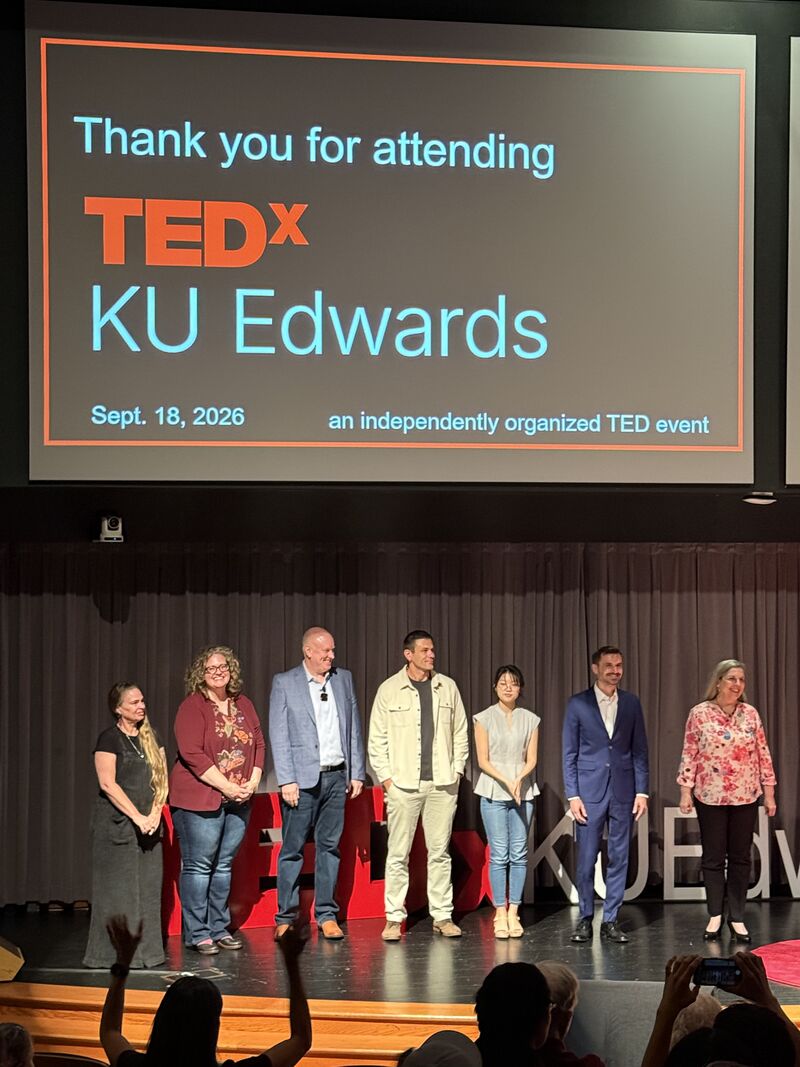
In September 2026, Scott Henderson was honored to take the TEDxKUEdwards stage alongside a lineup of genuinely great speakers — not to do a magic show, but to explain what thirty years of doing one taught him. Around year twenty, he noticed the trick was never the point. It was the excuse. What people actually walked away with was a connection, with him and with each other. The talk names the five things underneath that, proven live with rope, coin, and a jar of jellybeans (and, briefly, a handful of marshmallows headed straight for the audience).
- Event
- TEDxKUEdwards 2026
- Talk
- A Magician Reveals His Greatest Secret
- Venue
- Regnier Hall · KU Edwards Campus
- Date
- September 18, 2026
How a magician
ends up on a TEDx stage.
TEDxKUEdwards is the independently organized TEDx event hosted at the University of Kansas Edwards Campus in Overland Park, part of the same university where Scott earned his business degree, met his wife, and won the talent show that started his performing career. The 2026 lineup paired researchers, clinicians, and educators with a working magician, and asked him to talk about the thing he'd actually built a career on. Scott counts it an honor to have shared that stage with a genuinely excellent group of fellow speakers.
By day, Scott works in cybersecurity at NetSPI, building partnerships and helping organizations defend against the ways trust gets exploited. By night and weekend, he's been Magic Scott since 2000 — corporate stages, trade-show floors, birthday parties, one memorable Model T club. Both careers, it turns out, run on the same instinct: reading a room and knowing exactly what will make people trust you.
The trick was
never the point.
The talk opens the way Scott opens a lot of shows: no introduction, two ropes, a knot that jumps from one to the other — and then, mid-air, turns into a marshmallow. It's a strange way to start a talk about human connection. That's the point. Then he puts the props down and gets to the argument.
I've been doing magic for thirty years — trade shows, corporate events, birthday parties, one time a Model T club. And somewhere around year twenty I noticed something. The trick was never the point. The trick was the excuse. What people actually walked away with was a connection — with me, and with each other.
From there, the talk breaks that pattern into five things — none of which require knowing a single magic trick.
That marshmallow from the opening comes back later in the talk — when Scott makes the case for always having a backup plan, he illustrates it by pulling out a handful of extra marshmallows and tossing them straight into the audience. If the first one doesn't land, you've got more where that came from.
What thirty years
on stage taught him.
-
I.
Be Worth Remembering
The thing that doesn't fit the pattern is the thing your brain hangs onto — psychologists have called it the Von Restorff effect since 1933. Scott has people describe tricks he did for them twenty years ago like it happened that morning, not because the trick was flawless, but because it was different. The talk's version for the room: everyone has a weird fact, a hobby, a story they're holding back because it feels irrelevant. It's the only reason anyone remembers you.
-
II.
Make Them Feel Something
Good magic is a gift: free, unexpected, and given without being asked. A Harvard and UBC study that handed people money and told half to spend it on someone else found the givers measurably happier by day's end. The talk's argument: you don't have to give a trick. Give your full attention, the detailed question, a smile you decided to give on purpose.
-
III.
Give More Than They Expect
The brain's reward center doesn't fire for the reward — it fires for the reward it didn't see coming, per neuroscientist Wolfram Schultz's 1997 research on dopamine and prediction error. Scott tells the story of a trade-show attendee named Quincy: a two-minute card trick that Quincy was still telling his wife about three New Year's Eves later. Researchers tracking a network of nearly five thousand people found happiness spreads three degrees out — to a friend's friend's friend. You rarely know how far the small thing travels.
-
IV.
Do It Before You're Ready
None of it works from inside the comfort zone — the marshmallow toss included; Scott still misses it sometimes, which is the whole reason it's worth watching. Researchers at the University of Mannheim found we consistently rate our own vulnerability as weakness, while the people watching read it as bravery: the "beautiful mess effect." Scott ties it to his own career, including a Monday-morning show for a company he'd never worked with that turned into a job offer — twice.
-
V.
It Brings People Together
Magic doesn't just connect the performer to the audience — it connects the audience to each other. A Yale study found chocolate rated as tasting better when eaten at the same moment as the person next to you, same chocolate, no talking required. It's why a room full of strangers laughs at the exact same beat, and why a Model T club decided what they wanted, more than a magic show, was something to have together.
Sources cited in the talk: Von Restorff (1933); Dunn, Aknin & Norton, Science (2008); Schultz, Dayan & Montague, Science (1997); Fowler & Christakis, BMJ (2008); Bruk, Scholl & Bless, Journal of Personality and Social Psychology (2018); Boothby, Clark & Bargh, Psychological Science (2014).
The full talk,
coming soon.
TEDx talks are typically posted
a few months after the event.
Scott delivered this talk live at TEDxKUEdwards on September 18, 2026. TEDx events post their talks to YouTube on their own schedule, usually within a few months of filming. Once it's live, the full talk will be embedded right here — check back, or follow along on the event's own page in the meantime.
Visit TEDxKUEdwards →The same talk,
built for your stage.
The TEDx talk is a distilled version of the same material behind Scott's Connection keynote — the idea that attention, not charisma, is what creates trust, proved live instead of argued from a slide. Conference organizers, sales-kickoff planners, and leadership teams book the full-length version of this talk (forty-five to ninety minutes, with an optional workshop add-on) the same way TEDx booked the eleven-minute one.
Scott is available for keynote engagements, association general sessions, and sales kickoffs built around this exact material, or any of his three signature keynote themes. A thirty-minute call is usually enough to shape it around your event.
Bring the talk
to your stage.
Conferences, sales kickoffs, leadership retreats, association meetings. A short conversation, a proposal within twenty-four hours.